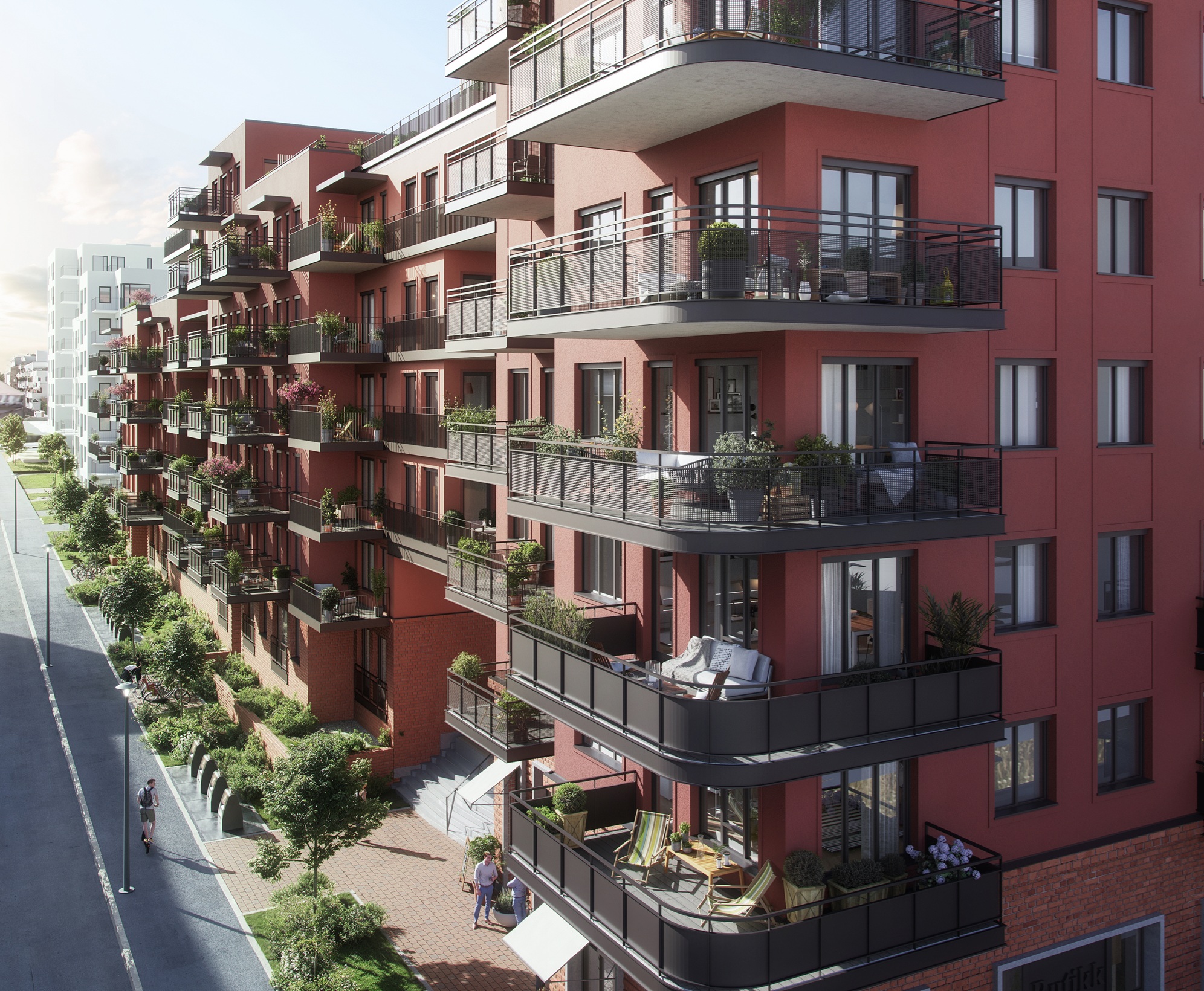

DIRECTORS’ REPORT Selvaag Bolig sold 466 units with a total value of NOK 3 036 million in 2025. Even though the market has been characterised by a certain degree of caution, the sales in 2025 have been satisfactory. At the end of the year, a total of 912 units were under construction, which was an increase of 83 homes compared with one year earlier.
OVERVIEW 2025
The year started with high market activity in Norway, but demand in the new housing market declined when the expected interest rate cut did not materialise in March. The rest of the year has seen some uncertainty in the market for new homes. Construction costs have stabilised at a relatively high level. In the large cities, where market prices are sufficiently high, it has nevertheless been possible to start sales and construction of projects.
The Swedish market was also characterised by uncertainty in 2025, with a large supply of homes and restrained demand. During the year, optimism increased somewhat in Stockholm, especially in central areas. In 2025, Selvaag Bolig had one project for sale in the outskirts of Stockholm. Sales have been challenging throughout the year, but the company experienced an increase in interest in the project towards the end of the year.
Overall, Selvaag Bolig's sales in 2025 were somewhat lower than sales in the previous year, but higher than in 2023. During the year, a total of 521 sales contracts were entered into for homes with a total value of NOK 3 463 million. Net sales, that is, sales adjusted for Selvaag Bolig's share in joint ventures, ended at 466 homes with a value of NOK 3 036 million. The relatively strong sales figures are due to the company having attractive projects in central locations, and the fact that the Selvaag Pluss lifestyle concept has been an important competitive advantage. The sales meant that the company succeeded in starting construction of 476 homes during the year. At the end of the year, the company had 912 homes with a sales value of NOK 6 574 million under construction, of which 60 per cent had been sold. 59 per cent of the planned completions in 2026 had been sold by the end of 2025, of which about half of the homes will be completed in the fourth quarter of 2026.
The company completed 393 homes and delivered 433 homes in 2025. This is lower than in 2024, and the decrease is due to the challenging market conditions in recent years, which have resulted in lower starts. In 2025, pre-tax profit ended at NOK 140 million.
Lervig Brygge, Stavanger
Selvaag Bolig has access to a significant land bank that can provide more than 10 400 homes in and around Greater Oslo, Stavanger, Bergen and Greater Stockholm, and searches systematically for more plots to further strengthen the project portfolio. Most of the plots are owned by Urban Property, which collaborates with Selvaag Bolig. Urban Property was established in 2020 to own Selvaag Bolig's plots, and the plots are purchased in stages, in line with project development. The collaboration also gives Selvaag Bolig the opportunity to buy new plots of land without having to tie up equity. In addition, Selvaag Bolig has several joint venture projects with 50 per cent ownership.
In 2025, Selvaag Bolig entered into agreements to purchase plots in Ski, Kolbotn and Drammen in Norway, which will provide approximately 900 new homes. This is more than construction starts, and the land bank has thus increased during the year.
At the end of the year, Selvaag Bolig had 82 employees. Due to market conditions, the staffing at Selvaag Bolig was not increased in 2025, and employees who left for various reasons were only replaced if this was critical for operations. The annual employee survey shows that employee satisfaction is still good. In 2025, the company received an overall score of 89 per cent, which is 2 percentage points higher than the result in 2023 and 2024.
Sustainability work remains an important priority for Selvaag Bolig. The board believes that ESG work is crucial for the company to be able to prepare the transition to a more climate-neutral society over time. The company will contribute to lower greenhouse gas emissions, have a conscious relationship with climate risk and nature considerations, and at the same time ensure sustainable, responsible and profitable business operations. Selvaag Bolig will continue to prioritise transparency in its sustainability efforts and report greenhouse gas emissions and other significant sustainability factors for the business.
Work on social sustainability has continued in 2025, where the focus has been to ensure safe construction sites, inclusive neighbourhoods and high customer satisfaction. Another important priority has been the further development of the lifestyle concept Selvaag Pluss, which is lifestyle housing with staffed common areas and the availability of social and practical services. The concept contributes to increased well-being, security and reduced loneliness for residents. It is also a competitive advantage for projects for sale, and in demand by our cooperation partners, municipalities and home buyers. Selvaag Bolig is continuously working on further developing the concept, and Pluss® Homes will be a central part of several of the projects that will start sales in the coming years. The company has also established the Selvaag Neighbourhood concept, which is a variant of Pluss where several people share the concept, which has fewer services and a lower monthly price. In addition, the company plans to launch the compact flat concept Selvaag City, which is a refinement of Selvaag Pluss, in Stockholm and in upcoming projects in Norway.
Selvaag Bolig has a solid financial position, large development projects and access to a significant land bank in areas with population growth and high housing demand. At the end of the year, equity was NOK 2.41 billion and the equity ratio was 35.4 per cent.
The company has had normal operations in 2025.
Dividend
The board proposes a dividend of NOK 1.00 per share for 2025.
THE GROUP’S BUSINESS
Selvaag Bolig is one of Norway’s leading housing developers. It buys and develops new housing land, and manages the whole value chain from acquisition of land to completion and sale of homes. The group concentrates on the areas in and around Greater Oslo, Bergen, Stavanger and Greater Stockholm. The development business embraces wholly owned projects as well as projects pursued as joint ventures with external investors. Selvaag Bolig manages all the projects. The Selvaag Pluss Service AS subsidiary offers services related to Selvaag Bolig’s Pluss Homes.
Selvaag Bolig does not operate its own construction business, but awards construction contracts on a project-by-project basis. That gives it the opportunity to select the best and most competitive contractor for each project. Subjecting construction contracts to competitive tendering increases flexibility and reduces market risk, while helping to tie up less capital and cut execution risk during the construction phase.
The group possesses a high level of expertise on project development. With a modern and industrial approach to housebuilding, this helps to ensure lower construction costs, competitive prices for buyers and high profitability for the company and its owners.
Selvaag Bolig continues Selvaag’s historical social commitment, where value creation is combined with useful measures for society. The company develops large projects with a broad range of housing types and aims to create homes affordable to as many people as possible. Furthermore, Selvaag Bolig seeks to be a driver in the public debate in order to secure operating parameters which make it possible to build homes for as many people as possible while simultaneously ensuring good and sustainable housing and urban development. By building good and durable projects, which take into account social and aesthetic properties, in established urban and residential areas and near public transport hubs, the company supports more sustainable everyday living, with convenient access to shops, services and public transport within walking and cycling distance. Selvaag Bolig also supports educational institutions and mass-participation sports, the latter particularly in the neighbourhoods where the company has projects.
In January 2020, a large part of Selvaag Bolig’s available land portfolio was sold to Urban Property. These two companies intend to pursue a long-term strategic collaboration which offers them both several advantages. Where Selvaag Bolig is concerned, the collaboration’s benefits include increased competitiveness in land purchases and a reduction in tied-up capital. See Description of the business elsewhere in this report for further information.
FINANCIAL REVIEW
Income statement (Figures for 2024 are presented in brackets)
Operating revenues
Selvaag Bolig had operating revenues of NOK 2 086.6 million (NOK 1 971.0 million) in 2025. Revenues from units delivered accounted for NOK 2 002.4 million (NOK 1 661.3 million) of the total. The group has not sold any wholly owned land plots or commercial property in the period, but in 2024, the group sold two properties, one in Bærum and one in Lørenskog, for a total of NOK 229.9 million. During the year, a total of 433 units (532) were delivered, including 342 (343) from consolidated project companies and 91 (189) from joint ventures.
Operating costs
Operating costs totalled NOK 2 029.4 million (NOK 1 845.1 million), of which project costs for the year totalled NOK 1 767.3 million (NOK 1 580.3 million). Project costs are primarily construction costs for units delivered. Payroll costs accounted for NOK 146.7 million (NOK 149.1 million) of the operating costs.
Other operating costs came to NOK 108.6 million (NOK 106.0 million), including NOK 39.9 million (NOK 35.1 million) for sales and marketing.
The share of profit from associates and joint ventures came to NOK 69.4 million (NOK 72.3 million). The result in 2025 included a gain of NOK 21.7 million from the sale of Selvaag Bolig’s share of a joint venture project in Ski to collaboration partner Urban Property.
Operating profit
Consolidated operating profit for the year came to NOK 126.7 million (NOK 198.2 million).
Financial items
Net financial income amounted to NOK 12.9 million (NOK 11.0 million).
Profit (loss)
Pre-tax profit for the year was NOK 139.6 million (NOK 209.2 million). Net tax expense was NOK 6.6 million (NOK 32.2 million). Consolidated tax expense does not include tax liability for tax objects which are not part of the Selvaag Bolig group. Tax on non-controlling shareholders’ share of profit for the period is included in the non-controlling share of profit and equity.
Comprehensive income came to NOK 133.0 million (NOK 177.0 million). NOK 133.0 million of the profit was attributable to the shareholders of Selvaag Bolig ASA (NOK 177.0 million), and NOK 0.0 million to non-controlling shareholders (NOK 0.0 million).
Cash flow
Consolidated cash flow from operational activities was NOK -1 310.1 million (NOK 87.1 million). The decrease from last year primarily reflected the impact of changes in inventory.
Cash flow from investing activities was positive at NOK 81.3 million (positive at NOK 23.2 million).
Net cash flow from financing activities was NOK 1 100.0 million (NOK 6.8 million). The change from 2024. The change from 2024 is primarily related to higher net issuance of construction loans in 2025.
The group’s holding of cash and cash equivalents at 31 December declined by NOK 128.8 million to NOK 254.8 million (NOK 383.6 million).
Balance sheet
Assets in Selvaag Bolig at 31 December 2025 totalled NOK 6 804.6 million (NOK 5 159.0 million). The carrying amount of consolidated inventories (land, housing under construction and completed homes) at 31 December was NOK 4 802.1 million (NOK 3 257.8 million).
Equity at 31 December was NOK 2 409.1 million (NOK 2 393.2 million), corresponding to an equity ratio of 35.4 per cent (46.4 per cent). The board proposes that a dividend of NOK 1.00 per share, corresponding to NOK 93.8 million, be paid to shareholders in Selvaag Bolig ASA for 2025. That represents 70 per cent of consolidated net profit for 2025. Selvaag Bolig ASA paid a dividend of NOK 117.2 million in the second quarter of 2025, based on the profit for 2024.
The group held cash and cash equivalents of NOK 254.8 million (NOK 383.6 million) at 31 December. Selvaag Bolig ASA, the parent company, held cash and cash equivalents of NOK 0.7 million (NOK 155.5 million) at 31 December.
At year end, consolidated interest-bearing debt amounted to NOK 3 036.0 million (NOK 1 613.1 million), of which NOK 1 098.1 million (NOK 935.4 million) was non-current and NOK 1 937.9 million (NOK 677.7 million) was current. The increase in interest-bearing debt in 2025 was attributable to higher construction activity and the associated construction loans. NOK 729.5 million of the current liabilities related to buyback agreements and seller credits to Urban Property (NOK 504.5 million). See note 26 for more information.
Other current non-interest-bearing debt amounted to NOK 499.0 million (NOK 352.7 million) at 31 December, of which advance payments by customers accounted for NOK 36.8 million (NOK 36.9 million).
Financing and debt
Consolidated interest-bearing debt can largely be divided into four categories: 1) top-up loans in the parent company Selvaag Bolig ASA, 2) land loans, 3) buyback agreements with Urban Property and 4) construction loans. At 31 December 2025, the group had no top-up loans, land loans of NOK 33 million, buyback agreements and seller credits with Urban Property of NOK 730 million and total construction loans of NOK 2 273 million.
Selvaag Bolig has a credit facility of NOK 300 million with DNB, maturing in December 2027. The facility has financial covenants, see note 29. In addition, the company also has an overdraft facility of NOK 150 million in the same bank which is renewed annually. At 31 December, no drawings had been made against either of these facilities.
Each project in Selvaag Bolig is organised as a single purpose vehicle (SPV). In addition to financing in the parent company, this means that each company seeks its own external debt financing for the development of a project. Land loans are converted to construction loans as the projects start up. Construction costs are fully debt-financed, and increased activity in the companies will accordingly mean that construction loans rise in line with progress. In Sweden, Selvaag Bolig guarantees the implementation of the projects through a self-debtor surety.
Going concern
Pursuant to section 3-3a of the Norwegian Accounting Act, the board confirms that the going concern assumption is realistic and that the financial statements for 2025 have been prepared on that assumption.
Events after the balance sheet date
There have been no events after the balance sheet date significantly affecting the group's financial position.
Parent company Selvaag Bolig ASA
Operating revenues for Selvaag Bolig ASA, the parent company, came to NOK 85.5 million (NOK 83.0 million), and the operating loss for the year was NOK 116.1 million (loss of NOK 123.5 million). Ordinary net profit for the year was NOK 114.0 million (NOK 64.7 million). Profit for 2025 included NOK 233.3 million (NOK 307.8 million) in group contributions received from subsidiaries. These internal items are eliminated in the consolidated financial statements.
Allocation of the net profit
The parent company, Selvaag Bolig ASA, made a net profit of NOK 114.0 million (NOK 64.7 million). The parent company’s equity amounted to NOK 1 980.6 million (NOK 1 964.1 million) at 31 December.
STRATEGY
The board participates in important strategic discussions during the year and conducts an annual audit of the company’s operational and financial strategy together with the executive management.
In 2025, the company has worked actively to manage the business in line with the adopted strategy, and to ensure that the company capitalises on the competitive advantages it provides. To ensure that Selvaag Bolig is a driving force in future-oriented housing and urban development, the annual review of the company's strategy includes a review of various topics, such as urban development, housing concepts, ESG, the residential environment, housing preferences, demographics, the sharing economy and digitalisation.
For more information on the group’s strategy, see the Description of the business in this report.
RISK AND RISK MANAGEMENT
Risk management
As a housing developer, Selvaag Bolig is exposed to risk related to land development, sales and the execution of housing and urban development projects. These factors can affect the group’s business activities and financial position. The board of Selvaag Bolig accordingly gives a high priority to dealing with and managing risk, and has established routines and control systems to limit overall risk exposure to an acceptable level.
Regular risk surveys contribute to raising awareness of the most significant risk conditions which could affect the business goals defined in the company’s strategy and how to deal with them.
The primary risk factors can be categorised as market, operational, financial and climate risk.
The board and senior management are covered by the company’s directors’ and officers’ liability insurance. Within the terms of the policy, this insurance covers personal liability that board members or senior executives may incur under applicable law.
MARKET RISK
Housing demand is influenced by a wide range of factors at both the micro and macro levels. Significant fluctuations in the general level of interest rates and/or material changes in other economic variables to which potential homebuyers are exposed may affect housing demand. Changes in housing demand could affect Selvaag Bolig’s ability to sell homes at budgeted prices within the planned time frames. Were the pace of sales to be lower than expected because of changes in market conditions, planned developments could be postponed. The company accordingly has internal requirements related to advance sales, where the general rule is that construction does not begin until homes corresponding to 60 per cent of the value of each building stage in the respective projects, or of the overall project, have been sold. Due to more challenging market conditions, several exceptions to this rule were made in 2025. However, the overall sales ratio for homes under construction remained above 60 per cent throughout the period.
OPERATIONAL RISK
Risk related to contractors
Selvaag Bolig draws on external construction companies and service providers in connection with developing and building new projects. As a result, it is exposed to the risk of loss and additional project costs if a contractor/supplier finds itself in financial difficulties. To reduce this risk, the company mainly enters into construction contracts with larger, well-established players who have solid finances and experience, as well as documented quality work. In addition, standardised and detailed project descriptions developed by Selvaag Bolig are used to reduce the risk of errors, misunderstandings and delays on the part of the contractor.
Furthermore, Selvaag Bolig is exposed to increases in the price levels of construction contracts. For projects built on site, the company mainly enters into turnkey contracts. In this way, costs are fixed before sales and construction begin. In the event of high turnkey contract costs, the company also has the expertise required to implement projects on the basis of subcontracts managed by the construction client. However, this is limited to a smaller proportion of the portfolio, for capacity and risk reasons.
Planning approval risk
Changes to operational parameters or planning decisions by the relevant public authorities could affect both the progress and the viability of Selvaag Bolig’s various projects, and might thereby limit opportunities to continue developing its properties. That could lead to delays and increased costs. In order to reduce this risk, the company performs a thorough analysis before buying land, and works systematically to keep in touch with regulators during the whole life of the project.
Access to land
Insufficient access to land plots in Selvaag Bolig’s geographic target areas could influence the company’s long-term growth targets. Selvaag Bolig thus works systematically with land purchases in Norway and Sweden. The company strives to be a preferred collaborative partner for landowners, and is in a continuous dialogue about new business opportunities.
FINANCIAL RISK
Credit risk
The group’s credit risk relates largely to the settlement of its accounts receivable, which primarily involve private customers as housebuyers. Buyers are primarily required to pay a NOK 100 000 deposit in advance when a sale is agreed, and to document satisfactory financing for the property. Credit risk is regarded as low because payment must be made to the client account at the settlement agent before transfer of the residence.
Foreign exchange risk
The vast majority of the group's activities are based in Norway. The company also has operations in Sweden where project development is financed with capital from the Norwegian operations, and profit repatriation entails a capital transfer from Sweden to Norway. No currency hedging arrangements have been established yet. The company considers the exposure to currency risk to be limited as the Swedish operations make up a low proportion of the total project portfolio and the company has therefore not yet formed a foreign exchange policy.
Interest rate risk (own financing, deposits)
Changes in interest rates affect the group’s borrowing costs and could affect the valuation of its assets. The company has opted not to enter into any forms of hedging contracts. Furthermore, interest rate levels affect the company’s return on free liquidity.
Financing risk (access to capital)
Selvaag Bolig depends on access to capital in order to acquire sites and realise projects. In order to finance construction, the company maintains good and close relations with its principal banks, which are well-capitalised Nordic institutions. Competition between the banks is perceived to be satisfactory, and the company has thereby been able to secure the financing required for its projects. Financing of land purchases is primarily channelled through the collaboration with Urban Property AS or joint ventures. In Sweden, land plots are mainly financed with equity and bank financing, but the company also has a cooperation agreement with Urban Property to finance land plots if necessary. Land purchase models are described in Description of the business in this report.
Liquidity risk
Conservative liquidity management means having sufficient liquid assets and available financing through lines of credit to meet the group’s obligations. Selvaag Bolig administers liquidity actively and pays special attention to maintaining adequate liquidity at all times. The company continuously monitors forecasted and actual cash flows.
The board takes the view that the group had a well-balanced exposure to financial and liquidity risk at 31 December. Cash and cash equivalents in the Selvaag Bolig group amounted at 31 December to NOK 254.8 million (NOK 383.6 million) for the group and NOK 0.7 million (NOK 155.5 million) for the parent company. Liquid assets consisted primarily of cash and bank deposits. Selvaag Bolig has a credit facility of NOK 300 million with DNB, maturing in December 2027. The facility has financial covenants, see note 29. The company also has a credit facility of NOK 150 million in the same bank which is renewed annually. At 31 December, no drawings had been made against either of these facilities. Further reference is made to the comments on financing above and to note 16 in the consolidated financial statements for an overview of loans, maturities and loan terms.
CLIMATE RISK
Climate risk consists of physical climate risk and transition risk. Physical risk is associated with increased extreme weather and ecosystem changes. Transition risk is associated with changes in regulations, technology and the market situation in connection with the transition to a low-emission society.
The company follows strict legal and regulatory requirements for physical climate risk, and Selvaag Bolig also has its own management systems that reduce risk. Selvaag Bolig is also exposed to transition risk. Given the property sector's significant contribution to greenhouse gas emissions and land use, the business faces increased demands for transparency, non-financial reporting and reduction of emissions, particularly from financial players and authorities. The company has implemented risk-reducing measures and will continue this work in 2026. These are discussed in the chapter Sustainability in Selvaag Bolig report.
ORGANISATION
Selvaag Bolig ASA is the parent company for the underlying group subsidiaries, which are responsible for operations. At 31 December 2025, the Selvaag Bolig group had 82 employees. 56 full-time equivalents were in the parent company and 26 in the subsidiaries. The company is led by CEO Sverre Molvik and chief operating officer (COO) Øystein Klungland.
CORPORATE SOCIAL RESPONSIBILITY (CSR) AND SUSTAINABILITY
Selvaag Bolig will create value for society by building good homes, and by working actively to ensure sustainable housing and urban development. This means in part that the company gives priority to urban areas experiencing expansion pressures, develops site-efficient homes with the greatest volume in lower price categories, seeks to be cost-effective and works to ensure positive official policies through a clear presence in the public debate. Ethical, social and environmental considerations are integrated in its day-to-day operations. The company’s goal is to be a good and secure workplace, and requires that it and its suppliers pursue their operations in compliance with applicable legislation and regulations. Furthermore, Selvaag Bolig will be a responsible social player and minimise emissions/discharges and damage to the natural environment. The company has ethical guidelines and a supplier declaration which are described at www.selvaagboligasa.no. Continuous efforts are made to ensure that employees are familiar with and observe all the company’s guidelines related to CSR and ESG.
The statement on due diligence assessments is published in a separate report available at www.selvaagboligasa.no. The statement on Equality and diversity is published in this report.
In 2025, the Selvaag Bolig further developed its ESG work based on a double materiality assessment and voluntary reporting in accordance with the Voluntary Sustainability Reporting Standard (VSME) framework. The company has prepared a greenhouse gas inventory for the fifth time. Sustainability efforts have focused in particular on climate, safe construction sites, employees, customers and responsible governance in the value chain, and form the basis for the company’s continued sustainability priorities.
See the separate chapter about Sustainability in Selvaag Bolig in this annual report.
SHAREHOLDER INFORMATION
The company was listed on the Oslo Stock Exchange on 14 June 2012. It had 6 595 shareholders (6 879) at 31 December 2025, of whom 151 were foreign (186). See note 13 to the consolidated financial statements for Selvaag Bolig ASA for detailed shareholder information.
Transactions with related parties
Urban Property (UP) is a related party to the company under the accounting rules, which means that ongoing option premiums and repurchases of land are considered related party transactions. During 2025, the company purchased five land plots from UP for a total of NOK 684.3 million. Furthermore, Selvaag Bolig sold its share of a partially owned project in Ski to UP for NOK 44.4 million. During 2025, a new option agreement was entered into with UP, related to a property in Nordre Follo municipality.
Refer to Note 23 for further information about the company’s transactions with related parties.
CORPORATE GOVERNANCE
Selvaag Bolig ASA is committed to maintaining a high standard of corporate governance. A healthy corporate culture is essential for safeguarding confidence in the company, securing access to capital and ensuing good value creation over time. All shareholders will be treated equally, and a clear division of labour will exist between the board and the company’s executive management. Selvaag Bolig complies with the Norwegian code of practice for corporate governance.
A detailed statement on the way Selvaag Bolig implements the sections of the code can be found on the company’s website at Selvaag Bolig ASA and in this annual report.
PAY AND OTHER REMUNERATION
Pay and other remuneration of senior executives in the group are presented in note 22 to the consolidated financial statements. This note also outlines the principles on which executive remuneration is based. Selvaag Bolig introduced a share savings programme for all employees and a share purchase programme for the executive management in 2015. These programmes are described in the chapter on corporate governance in this report.
ANNUAL GENERAL MEETING (AGM)
The AGM will take place on 30 April 2026.
OUTLOOK
Selvaag Bolig is well-positioned with large projects in growth areas in and around the largest cities in Norway and Greater Stockholm. According to Statistics Norway, urbanisation and population growth create a large and long-term need for new homes in Selvaag Bolig's core areas. In 2025, the company has started construction of more homes than were completed, thereby increasing its order backlog compared to the end of 2024.
The company plans several sales launches in the period ahead and will bring projects to market in line with demand. Limited supply of new homes, real wage growth, expectations of lower interest rates over time and signs of improving confidence among potential buyers support the company’s positive outlook for housing demand. However, uncertainty related to the development of new home sales due to geopolitical tensions and macroeconomic conditions, will continue to affect the timing of new project starts and, consequently, the number of homes under construction.
As a pure housing developer, the company puts all construction out to competitive tender and accordingly has a sensible staffing level that can easily be adjusted to the level of activity in the market. In the board’s view, this has given and will continue to give Selvaag Bolig competitive advantages. The company's strategic collaboration with Urban Property, good cooperation agreements, and establishment in Stockholm, will be able to give the company significant advantages over time.
Selvaag Bolig is well equipped organisationally, operationally and financially to maintain and strengthen its market position in the future. The company still has a good order backlog, a solid land bank in the company's focus areas and available capital through the agreement with UP to purchase new land.
Oslo, 18 March 2026