
SUSTAINABILITY IN SELVAAG BOLIG
Contributing to society has been a key component of Selvaag’s DNA since the beginning in 1948, when the focus was to build homes at prices most people could afford. With climate change, the environmental crisis, demographic changes and increasing social inequalities, both the area of responsibility and the efforts of the company are expanding. Selvaag Bolig considers an increased focus on sustainability in all phases of the business to be essential, and therefore is working systematically to make environment, social and governance (ESG) issues an integrated part of the business. Selvaag Bolig has operations in Norway and Sweden, which are countries that already have strict requirements for responsible operations, construction and quality. The company works purposefully to reduce negative impacts on the climate and nature, while at the same time contributing positively where possible.
There were no known violations of laws, regulations or guidelines in 2025.
This chapter elaborates on the ESG status summarised earlier in the report.
KEY FIGURES, SUSTAINABILITY
Environment (E)
| 2025 | 2024 | Goal | |
|---|---|---|---|
| Greenhouse gas emissions (estimates) | |||
| Scope 1 (tCO2e) | 0 | 1.3 | ✓Climate neutral by 2030 |
| Scope 2 (tCO2e) | 1.7 | 2.4 | ✓Climate neutral by 2030 |
| Scope 3 (tCO2e) | 10 045 | 10 944 | |
| CO₂ per m² GFA (kgCO2e) (completed areal with basement and foundation) | 202 | 179 | ✓2030: 20% lower than basis year 2022 (343) ✓2050: 30% lower than base year 2022 (343) |
| Waste | |||
| Sorting rate from construction sites (%) | 86% | 91% | ✓ >75% |
Social conditions (S)
| 2025 | 2024 | Goal | |
|---|---|---|---|
| Customers | |||
| Customer satisfaction at delivery (industry average) | 84 of 100 (77) | 80 of 100 (73) | ✓ Equal or better than sector average |
| Employee – work environment and diversity | |||
| Employee satisfaction (%) | 89% | 87% | ✓ > 80% |
| Sickness absence (%) | 5.9% | 3.0% | < 3% |
| Turnover (%) | 12.1% | 12.8% | |
| Female share of employees (%) | 55% | 58% | ✓ > 40% of each gender |
| Female share of managers (%) | 40% | 50% | ✓ > 40% of each gender |
| Female share of board (shareholder-elected directors) | 40% | 40% | ✓ > 40% of each gender |
| Health and safety on construction sites | |||
| Fatal accidents on construction sites | 0 | 0 | ✓ 0 |
| Lost-time injuries per million man-hours worked | 2.4 | 1.0 | 0 |
Governance (G)
| 2025 | 2024 | Goal | |
|---|---|---|---|
| Ethics, compliance and supply chain | |||
| Reported violations of human rights, corruption and financial crime | 0 | 0 | ✔ 0 |
| Reports of concern received | 0 | 0 | ✔ 0 |
| ESG integration in governance | |||
| ESG as KPI in variable pay | Yes | Yes | |
ABOUT THE SUSTAINABILITY REPORT
Basis for preparation (VSME B1)
The report has been prepared on a group basis and includes all business areas in Selvaag Bolig ASA with subsidiaries and associated companies. The report has been prepared by Selvaag Bolig's executive management and reviewed by Selvaag Bolig's board of directors. The report has not been audited or verified by external parties.
The report focuses on material topics for the company, follows the framework in the VSME basic module and the company has also chosen to add some modules from the VSME detailed module where it is considered material for Selvaag Bolig.
For further information, see Appendix: Details on ESG and other parts of the annual report.
PRACTICES, POLICIES AND FUTURE INITIATIVES FOR TRANSITIONING TOWARDS A MORE SUSTAINABLE ECONOMY (VSME B2)
Sustainability is a central topic in Selvaag Bolig, and the company has therefore established routines, policies and initiatives for transition to a more sustainable economy. ESG is a central topic in strategy processes, the board receives reports containing ESG information from the company's management in board meetings throughout the year, and KPIs and assessment of target achievement are adopted annually.
The company has a number of governing documents, of which the following are related to ESG:
- Environmental policy (available externally on the company's website)
- Ethical guidelines (available externally on the company's website)
- Supplier code of conduct (available externally on the company's website)
- Values manual
- Human rights policy
- Guidelines for IT security and GDPR
- Guidelines for renumeration of senior executives
Quality management of construction projects
Selvaag Bolig has a quality management system that safeguards and ensures quality and regulatory obligations in all phases of project development. As part of this, the company has an environmental management tool, including an ESG checklist with relevant KPIs and targets. This is to ensure that all relevant ESG factors are addressed in project development and that the company achieves its communicated goals. The project's climate and environmental performance is measured against the company's own KPIs and targets, as well as relevant reporting requirements.
Selvaag Bolig has also established routines, objectives and guidelines for sustainability that cover significant topics beyond those related to construction projects. These topics are discussed in more detail in the following sections of the sustainability chapter.
Risk
The company carries out an extensive biennial risk survey where a number of ESG-related topics such as climate risk, labour conditions at suppliers, compliance with requirements for non-financial reporting and governance issues are handled. The assessment was last carried out in January 2025. See the separate chapter on risk in Corporate governance.
Reputation
Selvaag Bolig continuously monitors how the company is perceived by key stakeholders such as authorities, partners, owners and investors. Based on dialogue and ongoing feedback, the administration believes that the company has a good reputation, particularly in terms of quality, reliability and responsible operations. Reputation is considered an important prerequisite for good regulatory processes in the municipalities and for being able to realise housing projects in collaboration with public and private actors.
Incentives
Management incentives for ESG have been introduced. The entire company's executive management has parts of its variable salary linked to ESG. The company's project management team has ESG KPIs tied to their variable salary.
For more information on routines, policies and future initiatives, see Appendix: Details about ESG.
STRATEGY: BUSINESS MODEL AND SUSTAINABILITY (VSME C1)
The main purpose of Selvaag Bolig's sustainability strategy is to ensure that the company contributes to comprehensive, long-term and sustainable value creation in society, that the business model is adapted to a climate-neutral economy, and that the company's work with social conditions and the environment provides a competitive advantage.
Vision:
We make cities better
Mission:
We make it easier for more people to live better
Ambition:
We contribute to inclusive local communities and facilitate a sustainable lifestyle
For more information about Selvaag Bolig’s business model and strategy, see Description of the business and other parts of the annual report.
Stakeholder dialogue and double materiality
The current strategy and material topics covered in this report are based on a materiality assessment last updated in 2024 in accordance with the CSRD/ESRS principle of a double materiality assessment (DMA). This means that the reporting and selected topics are both assessed from a two-dimensional approach that includes the impact the company has on society and stakeholders (impact materiality), as well as how ESG issues affect the company's opportunity for long-term value creation. Both internal and external stakeholders were consulted in the work, including experts on labour relations, finance and climate and environment to ensure a broad understanding of which topics are considered to be the most material for the company.
Through the DMA assessment process, Selvaag Bolig has identified the following topics as material (ESRS topic reference in brackets):
| Climate and environment | Social conditions | Governance conditions |
|---|---|---|
Climate change (E1): Adaptation to climate change, Climate change mitigation, Energy use Pollution (E2): Pollution of soil, air and water in the value chain Water (E3): Use of water-intensive products/materials in the value chain Biodiversity and ecosystems (E4): Drivers of biodiversity in the value chain, Restoration of green areas Resource use and circular economy (E5): Resource use, Waste | Own workforce (S1): Equality for own workers Workers in the value chain (S2): HSE in the value chain, Working conditions in the value chain, Equality for workers in the value chain Affected local communities (S3): Area development | Business ethics (G1): Corporate culture, Corruption and Bribery |
Selvaag Bolig has refined its role as a developer, and projects are therefore built by subcontractors. The company's biggest impact on the climate and environment, society and the economy occurs in the development of the housing projects and in the supply chain.
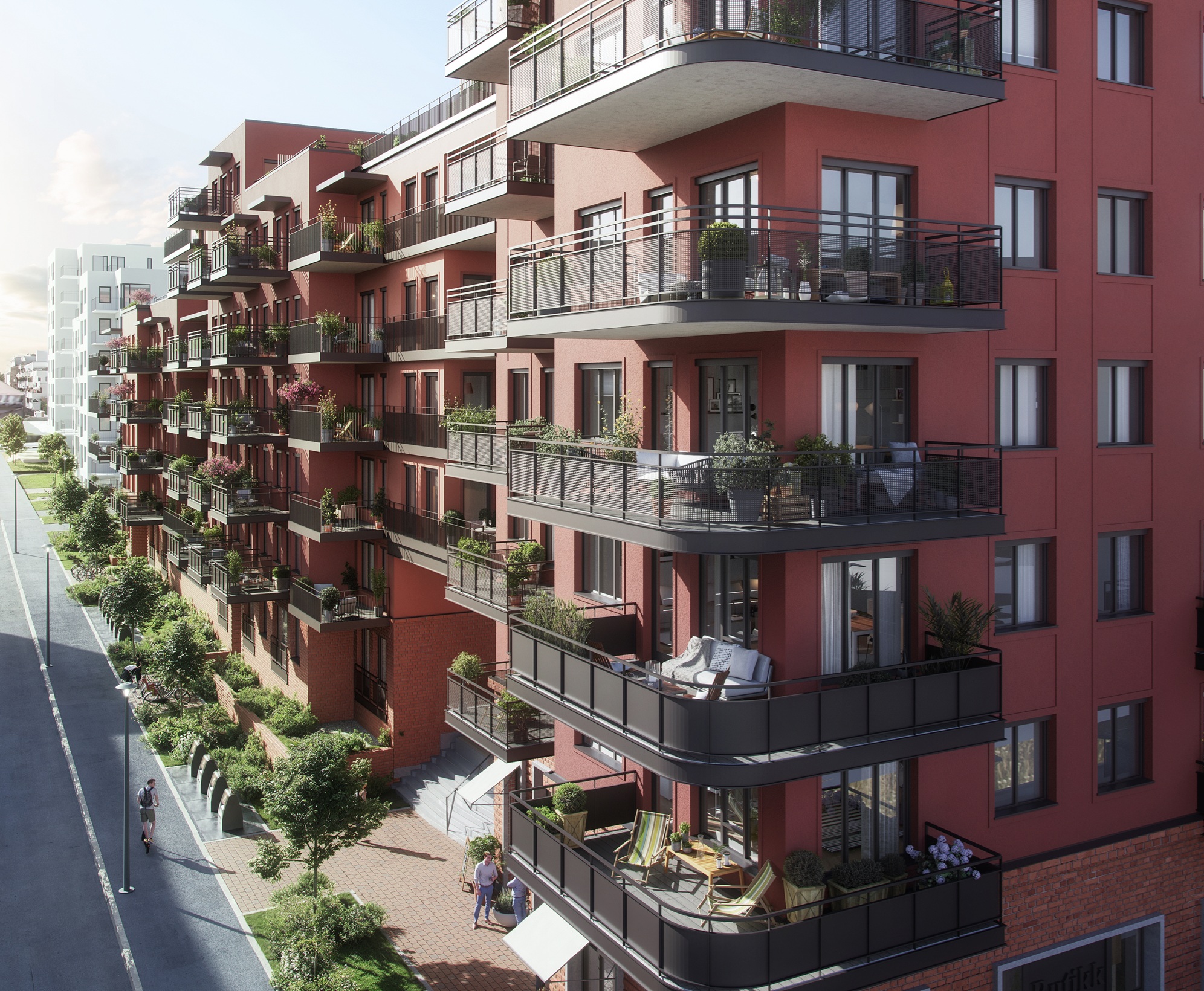
Ballerud Hageby, Bærum
CLIMATE AND ENVIRONMENT (E)
Selvaag Bolig has guidelines that ensure environmentally friendly solutions and reduced greenhouse gas emissions in the construction process and throughout the life of the buildings. All projects are built in line with Norwegian building regulations and relevant European regulations, which set strict requirements for material selection, energy efficiency and implementation.
The company prioritises area-efficient housing in urban pressure areas, where the transformation of former commercial and industrial areas contributes to sustainable urban development. The largest climate and environmental footprint lies in the supply chain, especially related to material use. Reducing emissions therefore requires close cooperation between Selvaag Bolig, authorities and contractors. Environmental considerations are integrated throughout the entire project cycle – from land purchase and planning permission to the selection of contractor and development. Ground conditions, biodiversity and energy solutions are mapped early, and all projects have their own environmental plans before construction begins.
ENERGY AND GREENHOUSE GAS EMISSIONS (VSME B3, C3)
Greenhouse gas emissions
About 40 per cent of global greenhouse gas emissions are linked to the construction, use and demolition of buildings. Selvaag Bolig has maintained greenhouse gas accounts since 2021 and emphasises transparency about emissions. Experience shows that emissions from construction sites have accounted for over 99 per cent of the company's total emissions in recent years, and this is therefore the main focus of climate work. Emissions from construction projects are classified as Scope 3 according to the GHG protocol.
The greenhouse gas emissions in 2025 confirm that Selvaag Bolig is on track towards its long-term goals. Emissions per completed m² of GFA were estimated to 202 kg CO2e, corresponding to 41 per cent lower than the base year 2022, and thus well ahead of the company's target of a 30 per cent reduction by 2050. The increase of 13 per cent from 2024 is mainly due to project mix and improved data quality, and is not considered to reflect a significant increase in greenhouse gas emissions under comparable conditions. Overall, the results show that Selvaag Bolig is able to reduce greenhouse gas emissions within a framework that ensures cost-effectiveness. Further goals and measures will be assessed over time, in light of developments in regulations, including proposed climate requirements in the Norwegian Building Regulations (TEK17) and several municipalities' ambitions for emission-free construction sites.
Selvaag Bolig will continue its work to limit the projects' greenhouse gas emissions, and will monitor new construction solutions and construction methods that reduce emissions and make it possible to increase the proportion of climate-friendly materials.
| Estimated greenhouse gas emissions | 2025 | 2024 | Goal |
|---|---|---|---|
| Direct emissions (Scope 1) (sum tCO2e) | 0 | 1.3 | Climate neutral by 2030 |
| Indirect emissions from energy usage, located-based (Scope 2) (sum tCO2e) | 1.7 | 2.4 | Climate neutral by 2030 |
| Indirect emissions from input factors (Scope 3) (sum tCO2e) | 10 045 | 10 945 | |
| Total emissions Scope 1, 2 & 3 (sum tCO2e) | 10 046 | 10 948 | |
| Emissions per m2 GFA with basement and foundation (kgCO2e) | 202 | 179 | 2030: 20% lower than base year 2022 2050: 30% lower than 2022 Emissions in base year 2022: 343 |
Energy
Norway has among the world's strictest requirements for new buildings, and with access to green energy, this is not considered to have a significant direct impact on the climate and environment. In contrast, energy saving in buildings can release energy that can contribute to emission reduction in other sectors.
Energy efficiency and the buildings' need for supplied energy are included in early-stage calculations in all projects. The energy profile of a planned building is an integral part of the project development, and renewable energy sources are always considered. Selvaag Bolig aims for the company's completed homes to have a maximum net energy requirement of 95 kWh per square meter of heated usable floor area (NFA) for the entire building including common areas. This is ensured through the requirements set out in the building regulations TEK17, which are followed in all construction projects.
For further information on the company's energy consumption, see Appendix: Details on ESG.
POLLUTION TO AIR, WATER AND SOIL (VSME B4)
Construction and construction activities in Norway and Sweden are subject to strict public requirements and regulations to limit the impact on air, water and soil. This includes, among other things, the Pollution Regulations, municipal permission planning and thematic guidelines for civil safety in spatial planning from the Directorate for Civil Safety and Emergency Preparedness (DSB). Selvaag Bolig carries out its projects in line with current regulations and sets clear requirements for contractors to ensure proper handling of masses, emissions, runoff, noise and dust on construction sites. Compliance is ensured through the company's quality management system and contracts with suppliers. This means, among other things, that the contractor must, when using chemicals hazardous to health, document that a risk and substitution assessment has been carried out, and that legally required safety data sheets for chemicals to be used have been submitted to the construction industry's substance register.
The contractor must notify Selvaag Bolig if there are any cases of air, water or soil pollution from the construction site. There were no known cases of significant pollution from the company's construction projects in 2025.
BIODIVERSITY (VSME B5)
Biodiversity loss is increasing globally and poses a threat to the planet's carrying capacity. Selvaag Bolig primarily builds homes in urban areas where there are already buildings. This often means that outdated industrial and commercial buildings and paved areas are transformed into residential areas with new parks and blue-green infrastructure that facilitate increased biodiversity.
Selvaag Bolig has implemented routines for all new projects to early map and assess the risk of biodiversity loss, or other conditions that may degrade nature, in connection with the purchase and development of plots. The board has also decided that the company will not purchase new plots of land with arable land. Exceptions to this apply if the plot has planning permission for residential purposes and/or is located at a junction and the development is socially and environmentally profitable. The company has not purchased plots of arable land in recent years and is not aware that any of the company's plots are in the immediate vicinity of areas with vulnerable biodiversity.
WATER (VSME B6)
The company’s direct water consumption is limited to office operations in leased premises and is therefore assessed as not material. Water withdrawals are not measured separately, as water consumption forms part of the buildings’ shared utilities and is managed by the landlord. An estimate of the company’s annual water withdrawal is included in the Appendix: Details on ESG, in accordance with VSME B6.
The company indirectly affects water consumption through the use of water-intensive materials in construction projects, such as cement, steel and glass. This is discussed in the section on resource use (B7).
The company has no offices or construction sites in areas with high water stress according to WRI's Aqueduct Water Risk Atlas.
RESOURCE USE, CIRCULAR ECONOMY AND WASTE MANAGEMENT (VSME B7)
The construction and civil engineering industry accounts for a significant share of global material consumption and waste, and the production of key construction materials such as cement, steel and glass is both energy and water intensive. Material use is also a significant source of greenhouse gas emissions.
Selvaag Bolig works systematically to ensure efficient use of resources and reduced waste throughout the entire project cycle – from planning and design to construction and completion. The company requires contractors to have waste plans, source separation and proper handling of construction waste, in line with current regulations and industry standards.
To reduce its climate and environmental impact, Selvaag Bolig is working on more circular solutions, including through reduced material use, increased reuse where appropriate, and stricter requirements in design and ordering. A goal has been established that the sorting rate for waste from construction sites should exceed 75 per cent. In addition, the company is working to increase the use of low-emission materials, including low-carbon concrete and use of wood.
The volume of waste generated from the company’s construction sites in 2025 was 44 per cent lower than in 2024, partly as a result of fewer housing units completed. Waste per square metre of completed gross floor area, which provides a more comparable measure of resource and waste efficiency, was reduced from 35 kg per m² GFA in 2024 to 24 kg per m² GFA in 2025. The sorting rate in 2025 remained well above the target of 75 per cent.
| 2025 | 2024 | Goal | |
|---|---|---|---|
| Waste (tonnes) | 1 197 | 2 131 | |
| Waste per m² GFA (kilo) | 24.1 | 35.0 | |
| Sorting rate (per cent) | 86 | 91 | > 75 |
CLIMATE RISK (VSME C4)
Climate risk is a key part of Selvaag Bolig's risk picture and includes both physical climate risk and transition risk.
In 2021, Selvaag Bolig conducted an assessment of climate-related risks and opportunities in line with the recommendations of the Task Force on Climate-related Financial Disclosures (TCFD). The analysis showed that both physical risk and transition risk are significant for the company and the industry as a whole. The company has identified the following main areas as particularly relevant:
Physical risk
Selvaag Bolig develops housing and commercial premises that are taken over by the buyer upon completion, and are subject to strict legal and regulatory requirements in the markets where the company operates. Physical climate risk is therefore a key factor in the assessment of site suitability, project design and feasibility.
Physical climate risk is primarily related to increased occurrence of extreme weather, including heavy rainfall, flooding, stormwater, landslides and storm surges, as well as more long-term changes in local climate conditions. Such conditions can affect the choice of site, construction solutions, progress and cost levels in individual projects.
All projects undergo risk and vulnerability analyses (RVA) in the early phase, where factors such as sea level rise, ground conditions, precipitation, frost and other relevant climate-related risk factors are assessed. The analyses are carried out in accordance with guidance issued by the Norwegian Directorate for Civil Protection (DSB) and form an integral part of the company’s management system. Climate risk is assessed during land acquisition and when seeking planning permission and is managed through adapted technical solutions, stormwater management and other risk-mitigation measures. Where necessary, measures are implemented throughout the project phases to reduce the risk of delays, cost increases and future damage, both during construction and after completion.
Transition risk
Transition risk is particularly linked to changes in regulations, public requirements, technology development and market expectations in the transition to a low-emission society. The real estate sector is facing increased demands for emission reductions, transparency and non-financial reporting from authorities, investors and lenders. For Selvaag Bolig, this could affect construction costs through requirements for material use, energy performance, documentation and reporting, as well as financial costs and operating conditions for project development. Changing preferences among homebuyers and municipalities can also affect the demand for different types of housing and solutions.
In the longer term, transition risk may become significant if the value chain as a whole must undergo a more extensive restructuring to meet expectations for significantly more climate-friendly and circular forms of living. In order to manage the transition to a low-emission society, Selvaag Bolig is working systematically with measures that combine reduced greenhouse gas emissions and cost-efficiency. This includes, among other things, standardisation, development of compact homes, conscious material choices and close cooperation with contractors and suppliers, as well as ongoing follow-up of innovation in materials, reuse, technology and construction techniques.
The company closely monitors developments in regulations and the market, including changes to the Building Regulations and the EU’s sustainability initiatives, and continuously assesses how new requirements and expectations may affect profitability and competitiveness. Transition risk forms part of Selvaag Bolig’s overall risk assessment, which is conducted every two years, most recently in 2025, and is followed up through the company’s overall risk management, project decisions and strategic priorities.
Overall, Selvaag Bolig considers climate risk to be manageable, given the company’s business model, geographical exposure and established governance processes. Climate risk is monitored on an ongoing basis and forms part of the company’s overall risk management, project decisions and strategic priorities.
Telekvartalet, Løren, Oslo
SOCIAL CONDITIONS (S)
The development of urban and housing projects often takes many years and affects many parties. Selvaag Bolig's handling of projects affects the local population around the construction projects, contractors and suppliers working on the construction sites, its own employees and future users of the areas being developed.
Selvaag Bolig's ambition is to build homes that contribute to an inclusive local community and a sustainable lifestyle. The housing projects are fashioned to make it possible for everybody, at every age, regardless of functional ability, to live well and in an environmentally friendly way. The company builds large projects with a wide selection of housing types and is working to develop housing that as many people as possible can afford to buy.
WORKFORCE
Selvaag Bolig strives to be one of Norway's most attractive workplaces and employees must have good opportunities for professional development. Selvaag Bolig desires a good, diverse and inclusive working environment characterised by mutual trust and respect.
General characteristics of the workforce (VSME B8)
At the end of 2025, the company had a total of 82 employees, five of whom were part-time employees. Six were employed in Sweden, and the remainder in Norway. There have been no reports of involuntary part-time work. The main functions are project management, and support functions such as finance, HR, legal, settlement, marketing, customer care and sales. The company also has service personnel who work in completed Pluss projects through operating agreements with the residential cooperatives.
Employee satisfaction
The company works purposefully with employee satisfaction, and has over time had good results in the company's employee surveys. For the tenth year in a row, Selvaag Bolig has been certified as a "Great Place to Work" and ranked as one of Norway's best workplaces. In 2025, the company received an overall score in the employee survey of 89 per cent. This is 2 percentage points higher than in 2024 and 2023. The results are particularly good in the dimensions of pride and community. 100 per cent of employees respond that they are proud to work at Selvaag Bolig, and 96 per cent feel that the company contributes positively to society.
Sickness absence and turnover
Selvaag Bolig has a target of keeping sickness absence below three per cent. Particular emphasis is placed on facilitating a good work–life balance and promoting physical activity through subsidised fitness programmes and group activities. In 2025, Selvaag Bolig had a sickness absence of 5.9 per cent, which was an increase of 2.5 percentage points from 2024, but roughly the same level as 2023. Since the company has fewer than 100 employees, a few people can have a major impact on the total level of sickness absence. The company has a good understanding of the reasons for sickness absence and follows routines for following up sick employees. The company health service provides assistance as needed.
Selvaag Bolig had a staff turnover of 12.1 per cent in 2025, which is on par with 2024. This dimension is also affected by the fact that there are relatively few employees in the company, and that a few people can have a big impact on the numbers. The company conducts exit interviews with those who leave to learn more about the reasons for leaving and follows up on this.
Remuneration, collective bargaining and training (VSME B10)
Selvaag Bolig operates in Norway and Sweden. All employees of Selvaag Bolig receive a salary that is competitive and in line with current industry practice and collective agreements, and is well above the levels that in practice function as the minimum wage in the market. The 56 employees of the parent company Selvaag Bolig ASA are covered by a collective agreement on an early retirement pension (AFP, Avtalefestet Pensjon). For more information about AFP, see the notes to the annual accounts.
Equality and diversity (VSME C5 and C9)
A fundamental principle at Selvaag Bolig is to emphasise and value expertise, and the company has zero tolerance for discrimination. As pointed out in the ethical guidelines, Selvaag Bolig does not accept any form of harassment or discrimination, whether based on race, religion, nationality, sexual orientation, gender or otherwise. Nor does the company tolerate any behaviour which could be perceived as threatening or degrading. Selvaag Bolig received no notifications about discrimination in 2025.
Selvaag Bolig has a specific goal of achieving gender balance in the various types and levels of jobs. The company follows the principle of equal pay for equal work. Hiring at Selvaag Bolig will be decided based on expertise and experience, regardless of the job level or function. The company shall, however, always try to obtain the best possible gender balance with a minimum of 40 per cent women or men.
The overall gender balance in 2025 was 45 per cent men and 55 per cent women, and thus in line with targets. 40 per cent of the company’s middle managers are women. The gender balance on the board of directors is in accordance with the gender balance requirement in the Norwegian Public Limited Liability Companies Act, with 40 per cent women and 60 per cent men among the shareholder-elected directors. Executive management consists of four people, of whom only one is a woman. Over time, Selvaag Bolig will strive to have a better gender balance in the executive management.
* Applies to directors chosen by the shareholders
One measure to contribute to equality is to arrange for a flexible and good arrangement in connection with employees' parental leave. Selvaag Bolig covers the basic salary above the mandatory 6G in connection with parental leave, facilitates graded or increased leave taking, and encourages men to take more leave than the minimum quota.
According to the Equality and Anti-Discrimination Act, Selvaag Bolig has mapped wage levels distributed by gender. The survey shows the average fixed salary according to the type of position and gender. Variable wages are not included in the survey as they vary greatly between different types of positions. Selvaag Bolig follows the principle of equal pay for equal work, and that women and men in the same type of position and with the same experience shall be equally paid.
In 2025, men had an average of 33 per cent higher salary than women, adjusted for employees in executive management and outside the core business. The salary gap is mainly due to the unequal distribution of women and men at job levels and functions, and the survey has not revealed any violations of the principle of equal pay for equal work. Women are mainly represented in customer-oriented roles, while men are in the majority in leadership roles and among project managers. Selvaag Bolig is working purposefully to improve gender balance over time, including through recruitment, with the goal of reducing overall salary differences and at the same time ensuring the right expertise in the organisation.
Co-ownership and benefits
Selvaag Bolig has a philosophy that co-ownership promotes value creation through increased engagement and loyalty. It is therefore arranged for employees to purchase Selvaag Bolig shares at a discount once a year. At the end of 2025, about 62 per cent of Selvaag Bolig’s employees owned shares in the company.
In addition, Selvaag Bolig has a number of benefits for employees. These include a mobile phone and broadband subscription, access to a subsidised cafeteria, discounted training at a fitness centre, as well as good pension and insurance schemes.
Expertise enhancement and appraisal interviews
All employees are given opportunities for professional development and expertise enhancement, including through courses, seminars and professional gatherings both in-house and externally. On average, employees participated in courses and training for about 11 hours per person in 2025. Examples of courses and training are mandatory e-learning courses in IT security, internal seminars, money laundering courses, conferences and more. In addition, all employees must have regular follow-up by their manager and an annual appraisal interview.
Health and safety (VSME B9)
There have not been any work-related accidents or deaths among Selvaag Bolig’s employees in 2025.
Further details and key figures relating to the workforce are published in Appendix: Details on ESG, as well as in the renumeration report, which is published on the company’s website. See the section on Safe construction sites for more information on health and safety at construction sites.
DUE DILIGENCE ASSESSMENTS AND HUMAN RIGHTS
Large development projects with many suppliers increase the risk of human rights violations and workplace crime. Selvaag Bolig takes its responsibility for safe construction sites, good working conditions, equality and the protection of human rights throughout the value chain seriously. The work is anchored in the company's ethical guidelines, Code of Conduct and human rights policy, based on the UN Guiding Principles and the Global Compact.
The following human rights have been assessed and prioritised as most prominent for Selvaag Bolig, based on severity and likelihood:
- Health and safety on the construction site (HSE)
- Social dumping and use of foreign labour
- Use of subcontractors
- Purchase of materials
Selvaag Bolig surveys and evaluates existing suppliers and partners continuously. Companies that, during a year, deliver goods and/or services with a total gross value exceeding NOK 10 million and/or are considered to engage in business representing significant risk are subject to extended control. The selection is made based on both risk and significant contract values and is not limited to where in the supply chain the risk lies. In daily work, the work is primarily carried out through the company's control routines and management system, which consists of management documents with checklists and routines. The overall work is led by the company's compliance group, which has consisted of, among others, the legal director, executive vice president of finance and executive vice president of marketing, strategy and sustainability.
Selvaag Bolig has not uncovered any violations of the Working Environment Act or human rights in 2025.
See the statement on due diligence assessments at www.selvaagboligasa.no for further information.
SAFE CONSTRUCTION SITES
Construction is one of the most accident-prone industries in Norwegian working life, and health and safety is therefore an important topic in the construction industry. The company has declared zero tolerance for labour-related crime and social dumping, and aims for zero harm to people and the environment.
Work relating to health, safety and the working environment (HSE) follows the requirements of the Norwegian Client Regulations and Internal Control Regulations, with a HSE plan for each project and ongoing follow-up of the main contractor. Contractors are required to comply with Norwegian legislation and collective agreements and must be able to document the lawful employment of their workforce. The company conducts regular inspections, and all incidents are reported on an ongoing basis. Executive management and the board receive quarterly HSE reports, and serious matters are reported immediately.
There have been few absenteeism injuries on Selvaag Bolig's construction sites, and the company continuously works to improve the overall control level and further reduce the number of injuries. In 2025 there were 3 absenteeism injuries on construction sites which led to an increase in lost-time injuries per million hours worked from 1.0 in 2024 to 2.4 in 2025. Total recordable injuries per million hours worked fell from 18.3 in 2024 to 7.8 in 2025. Selvaag Bolig continues to work together with its contractors to prevent injuries.
More details and key figures about safe construction sites is available in Appendix: Details on ESG.
INCLUSIVE LOCAL COMMUNITIES
Selvaag Bolig develops neighbourhoods with a focus on fostering positive interaction between new and existing residents. The company engages affected stakeholders early in the planning and development phases to safeguard local needs and mitigate adverse impacts related to noise, traffic and land use.
The aim is for people of all ages to live well and in an environmentally sustainable way, with access to high quality communal spaces, proximity to everyday amenities and a high standard of design. Residential projects can also have a positive impact on neighbourhoods, for example where former industrial areas are transformed into green communities with varied planting, playgrounds and shared spaces between buildings.
Architecture is integrated into project management and Selvaag Bolig works with leading architects and carries out stakeholder engagement processes. In addition, the company was actively involved in the public debate on architecture in 2025.
CUSTOMER SATISFACTION (KTI)
Selvaag Bolig works systematically with customer satisfaction (KTI) throughout the customer journey. In Norway, Prognosesenteret measures KTI at delivery and after one year of occupancy for most players in the industry. Selvaag Bolig's goal is a score on par with or higher than the industry. In 2025, the company achieved a score of 84 out of 100 at delivery – seven points above the industry and an improvement of four points from 2024. The good score and the increase over time are due to systematic work on quality and customer experience.
For 2025, Selvaag Bolig was named the best company and second best company in the industry, respectively, by Prognosesenteret after one year of occupancy and after delivery. The company's housing project Skifabrikken was also named the best project after one year of occupancy, and the projects Lille Løren Park and Langhus 1405 received a total of six positions on the top 10 lists for 2025.
| 2025 | 2024 | Goal | |
|---|---|---|---|
| KTI Score at delivery (industry average) | 84 of 100 (77) | 80 of 100 (73) | Equal to or above industry average |
Prognosesenteret also measures customer satisfaction for Selvaag Pluss Service, which operates the company's Pluss projects. Customer satisfaction among those living in Selvaag Pluss® Homes was 82 per cent in 2025, the same high level as the year before.
GOVERNANCE (G)
Good corporate governance is a prerequisite for trust, risk control and long-term value creation in Selvaag Bolig. The company is responsible for ensuring compliance with applicable laws and regulations in its own operations and in the value chain, including safeguarding human rights, decent working conditions and safety on construction sites. The work is anchored in clear ethical guidelines, requirements for suppliers and an established governance and control structure. ESG is integrated into risk management, decision-making processes and incentive schemes, and is followed up by executive management and the board.
For further information on corporate governance, see the chapter on corporate governance.
WHISTLEBLOWER ROUTINES
Selvaag Bolig has a low threshold for reporting censurable conditions, such as violations of the law or violations of ethical guidelines. The company offers an open and anonymous reporting channel available to employees and external parties via the website www.selvaagboligasa.no. Notifications are reported to the board according to established procedures. Employees and suppliers are informed about the possibilities for reporting. The company did not receive any reports of concern in 2025.
BUSINESS CONDUCT AND ETHICS IN OWN OPERATIONS (VSME B11)
As a construction client, Selvaag Bolig works with, among other things, public contact, significant financial transactions and agrees to large turnkey contracts. The company's ethical guidelines state that Selvaag Bolig does not accept any form of corruption. Conditions that can affect decision-making processes, or that may give others reason to believe such conditions exist, are not accepted. Nor should employees contribute to any kind of price cooperation that can distort or contravene current competition regulations. No cases of price cooperation or corruption were revealed in 2025.
Selvaag Bolig has established ethical guidelines for all employees. New employees are introduced to the guidelines through training programmes and joint meetings and are required to conduct e-learning courses in ethics and corporate social responsibility. The course ensures that all employees know what the requirements and expectations are, and is an important tool for building a company culture with high standards.
BUSINESS CONDUCT AND ETHICS IN THE SUPPLY CHAIN
The greatest risk of breaches of good business practice, such as corruption, working conditions and price cooperation lies in the supplier chain. Selvaag Bolig places clear requirements on suppliers by using a supplier declaration and contracts, and has routines that include the annual assessment of its main partners and suppliers. No violations of the company's guidelines were revealed in 2025.
PRIVACY (GDPR)
Selvaag Bolig receives personal information from both own employees and from customers who buy housing, and processes them in line with the EU General Data Protection Regulation (GDPR) and the Privacy Regulation. The company has strict routines for how such information is collected, stored, used and deleted. The company has a privacy group that goes through the company’s routines for privacy and performs regular spot checks. The company recorded no discrepancies during the year.
IT SECURITY
Selvaag Bolig works continuously to protect IT equipment, networks and information from unwanted access and attacks. Several measures have been implemented to increase IT security in recent years, including more advanced security monitoring, an updated information security management system and continuous work on improving the awareness of employees. All employees take an annual class in IT security using an e-learning platform and with user instructions for information security. In 2025, Selvaag Bolig has increasingly adopted artificial intelligence (AI) in its operations, and the responsible use of AI, including information security and data protection, has been a topic in the company’s IT security e-learning programme.
FURTHER PRIORITIES FOR SUSTAINABILITY
In 2026, Selvaag Bolig will continue to focus on measures that contribute to a reduced climate footprint in the company's construction projects, as well as further improving data quality in climate and sustainability reporting. In parallel, the company will continue to work on safe construction sites and inclusive communities, as an integral part of project development. Selvaag Bolig will also prioritise maintaining high employee and customer satisfaction, as well as ensuring good governance, compliance and business practices in its own operations and in the value chain.